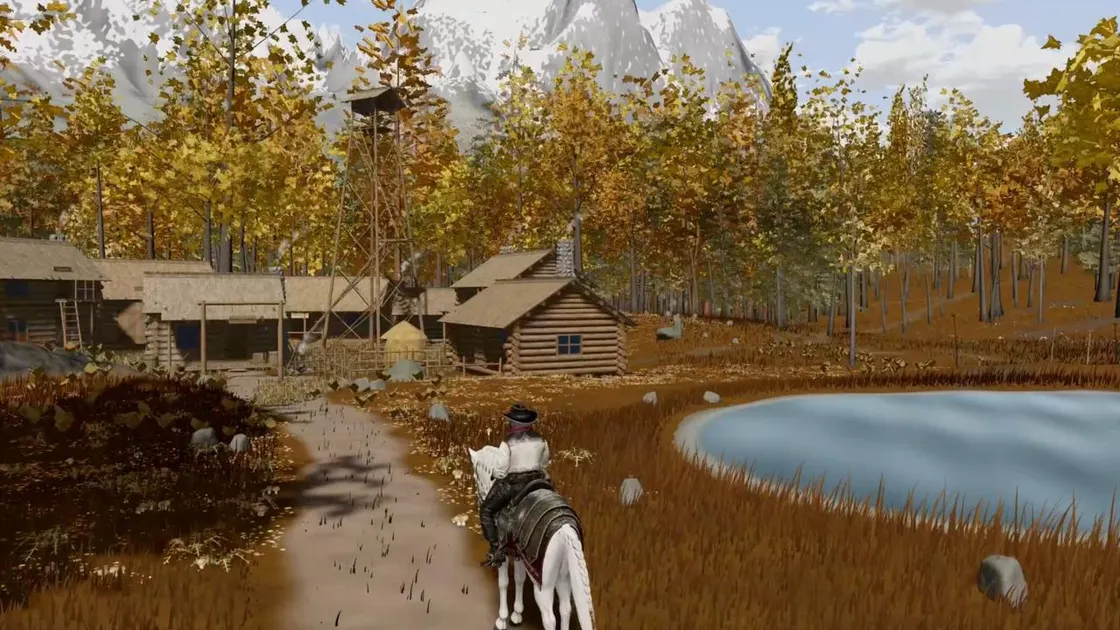
Kimi K3 Uses Three.js WebGPU for an AI-Built 3D Game Demo Moonshot’s Kimi K3 launch includes a notable WebGPU case study: an AI-built procedural 3D exploration game using Three.js WebGPU and GPU compute.
WebGPU Cluster Turns Browsers Into AI Inference Nodes Alexsandro Souza’s WebGPU Cluster turns browser tabs into shared AI inference nodes, with WebGPU hosts running RF-DETR or SmolVLM behind a simple HTTP API.
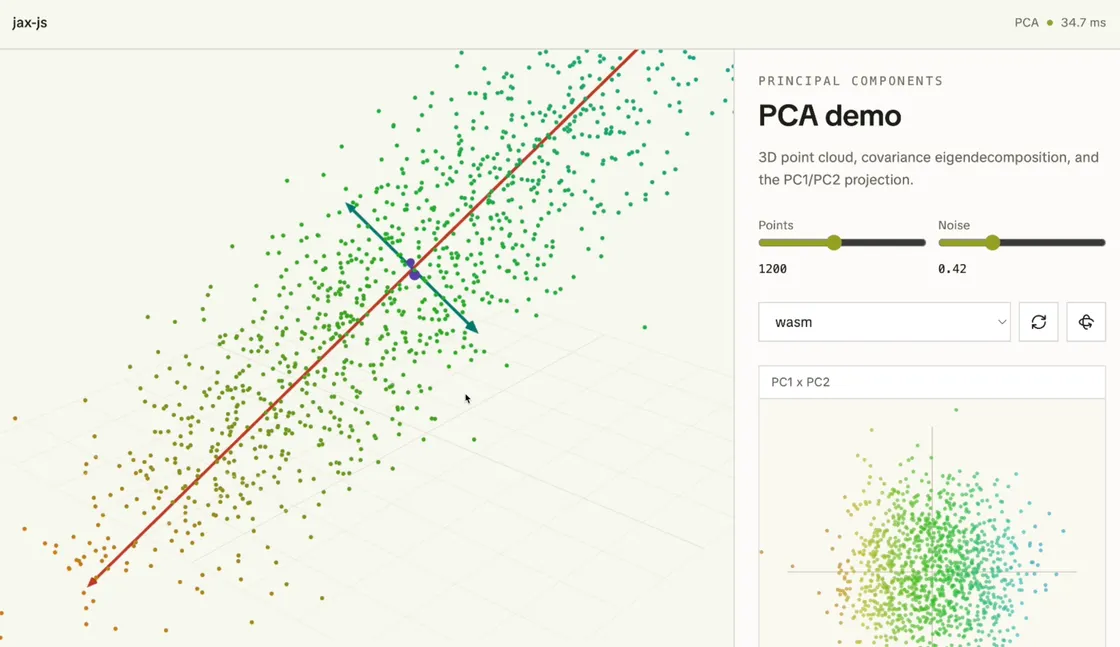
jax-js Brings JAX-Style ML Kernels To The Browser Eric Zhang’s jax-js is a pure JavaScript ML framework that compiles NumPy/JAX-style array code into WebAssembly and WebGPU kernels for client-side experiments.
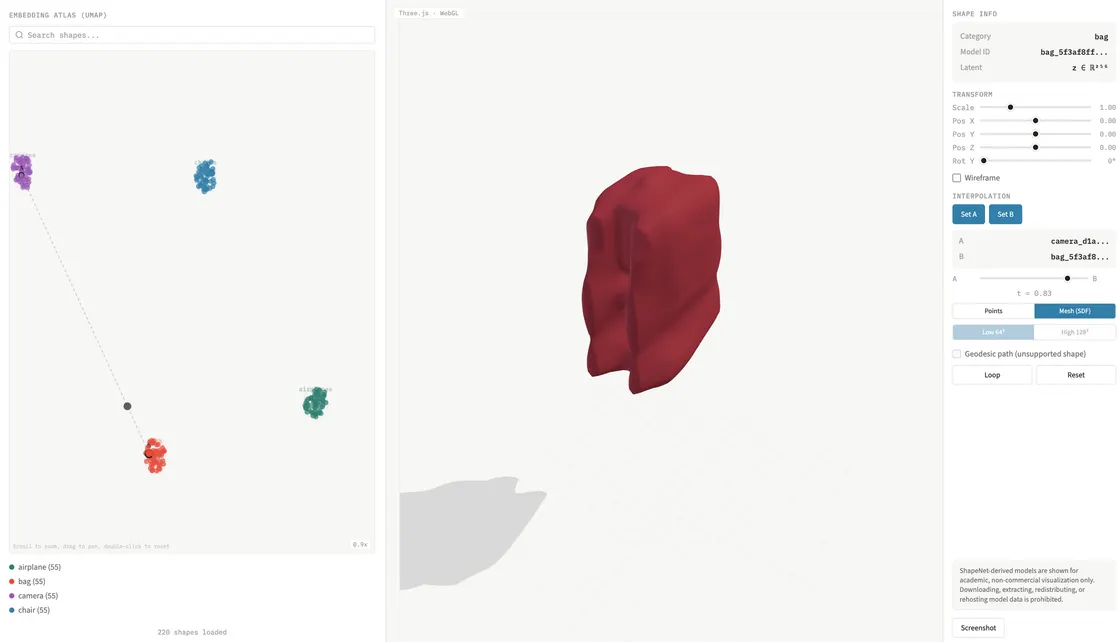
Walking Inside a DeepSDF Latent Space, in the Browser Click a dot in the UMAP atlas and a chair resolves from a 256-dim code. Drag a slider and watch it melt into a lamp, meshed live from a neural signed distance function at 64³ or 128³. DeepSDF latent spaces you can actually walk around in. Three.js, WebGL, no download.
Aimee's Papercraft World: A Scroll-Driven Portfolio Built From Folded Paper A hand-drawn character walks a looping path through a paper world that changes with the seasons. Built with Three.js, Blender, and Krita by baking flat Krita illustrations onto 3D geometry so the cardboard reads as cardboard from any angle. Open source, with a full tutorial.
PipeMagic: A WebGPU Node Editor for Image Pipelines A node editor for image pipelines that runs entirely in the browser. Wire up background removal, depth estimation, JFA outlines, and 2x upscale, watch WebGPU do the work, then export the graph as JSON and drop the same logic into your app in roughly 180 lines.
LFM2-MoE: An 8.3B Parameter Language Model Running Entirely in Your Browser via WebGPU Liquid AI's LFM2-MoE loads 8.3B parameters (1.5B active) and generates text client-side through WebGPU. No server, no API key. A hybrid convolution-attention architecture running Mixture-of-Experts inference in a browser tab, powered by Transformers.js.
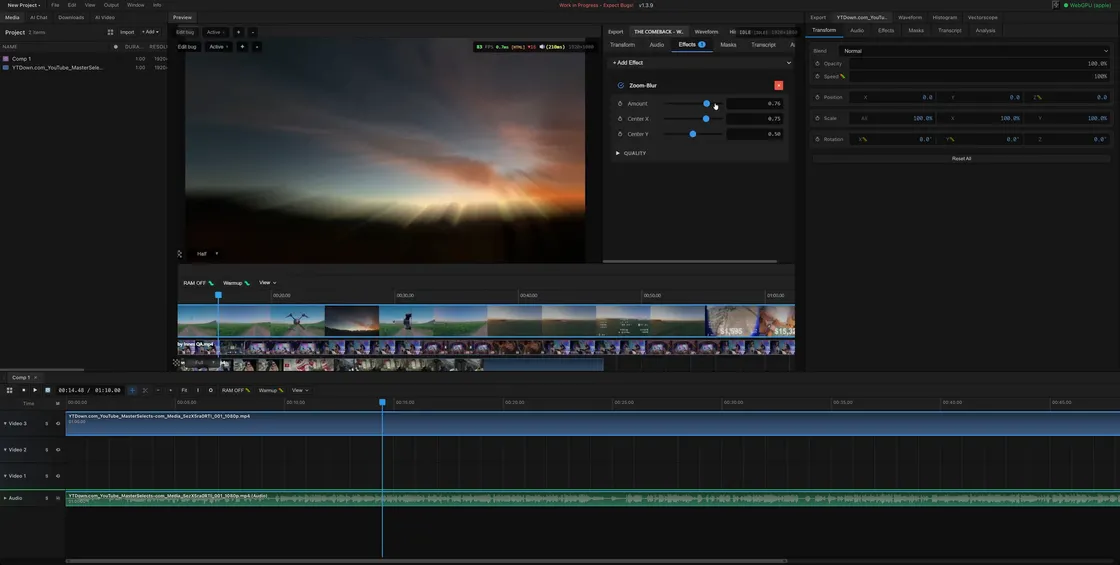
MasterSelects: A GPU-First Video Editor Built Entirely on WebGPU A full video editor running in the browser with zero CPU roundtrip. 37 blend modes in one WGSL shader, GPU-accelerated scopes, optical flow scene detection, and SAM2 segmentation on-device. 13 dependencies. MIT licensed.
DRIFT: A Million Particles, a Lost Astronaut, and AI-Generated Loneliness A lost astronaut records his diary in your browser. Over a million GPGPU particles shift with his mental state while AI generates fresh text and voice each visit. Ming Jyun Hung built something that feels alive and a little heartbreaking.
Orbiting a Single Photo: 3D Camera Control with Qwen Image Edit and Three.js Upload a photo, drag a Three.js camera to a new angle, and a diffusion model hallucinates what the scene looks like from there. 96 poses, trained on Gaussian Splatting renders, running in a single app.py.
UNESCO's Virtual Museum of Stolen Artifacts, Rebuilt in 3D with NanoGL A WebGL museum you weren't expecting to need. makemepulse rebuilt 240+ looted artifacts in 3D using their in-house NanoGL framework and a generative AI pipeline that turns flat photos into textured models. Architect Francis Kéré designed the space. The subject matter does the rest.
Embedding Atlas: Apple's Open-Source Tool for Exploring Millions of Vectors in Your Browser Apple's Embedding Atlas renders millions of embedding points interactively using WebGPU (with WebGL 2 fallback), Wasm-compiled UMAP, and density-based clustering that runs in milliseconds. Open source, with React, Svelte, Jupyter, and CLI support.
AI Grid: Run LLMs in Your Browser, Share GPU Compute with the World AI Grid connects browser tabs into a peer-to-peer compute mesh. Run LLMs locally with WebGPU, share spare GPU cycles, or borrow from others. No installs, no cloud. Just a URL and your graphics card.
Gauzilla Pro: Web-Native Gaussian Splatting for 4D Digital Twins A browser-based platform turning drone footage and smartphone video into photorealistic 3D scenes with AI-powered segmentation. Built on an open-source Rust/WASM renderer, no installs required. Construction teams are already using it for as-built documentation.
The Spark: A Scroll-Driven WebGL Story That Runs Like a Short Film A spark escapes into a city built to contain it. Scroll to push the story forward. cables.gl handles the 3D, Webflow stitches the UI, and the audio reacts to how fast you move. Projection mapping, CRT post-processing, and tight character animation make it feel like a game cutscene.
Active Theory Portfolio Active Theory's portfolio site is a technical flex: real-time particles, AI-powered navigation, and immersive 3D environments built on their custom Hydra framework. Twelve years of pushing browsers to their limits, and it shows.