
LiteRT.js brings Google's on-device inference runtime to JavaScript, giving browser applications one path across XNNPACK on CPU, ML Drift over WebGPU, and experimental WebNN acceleration.
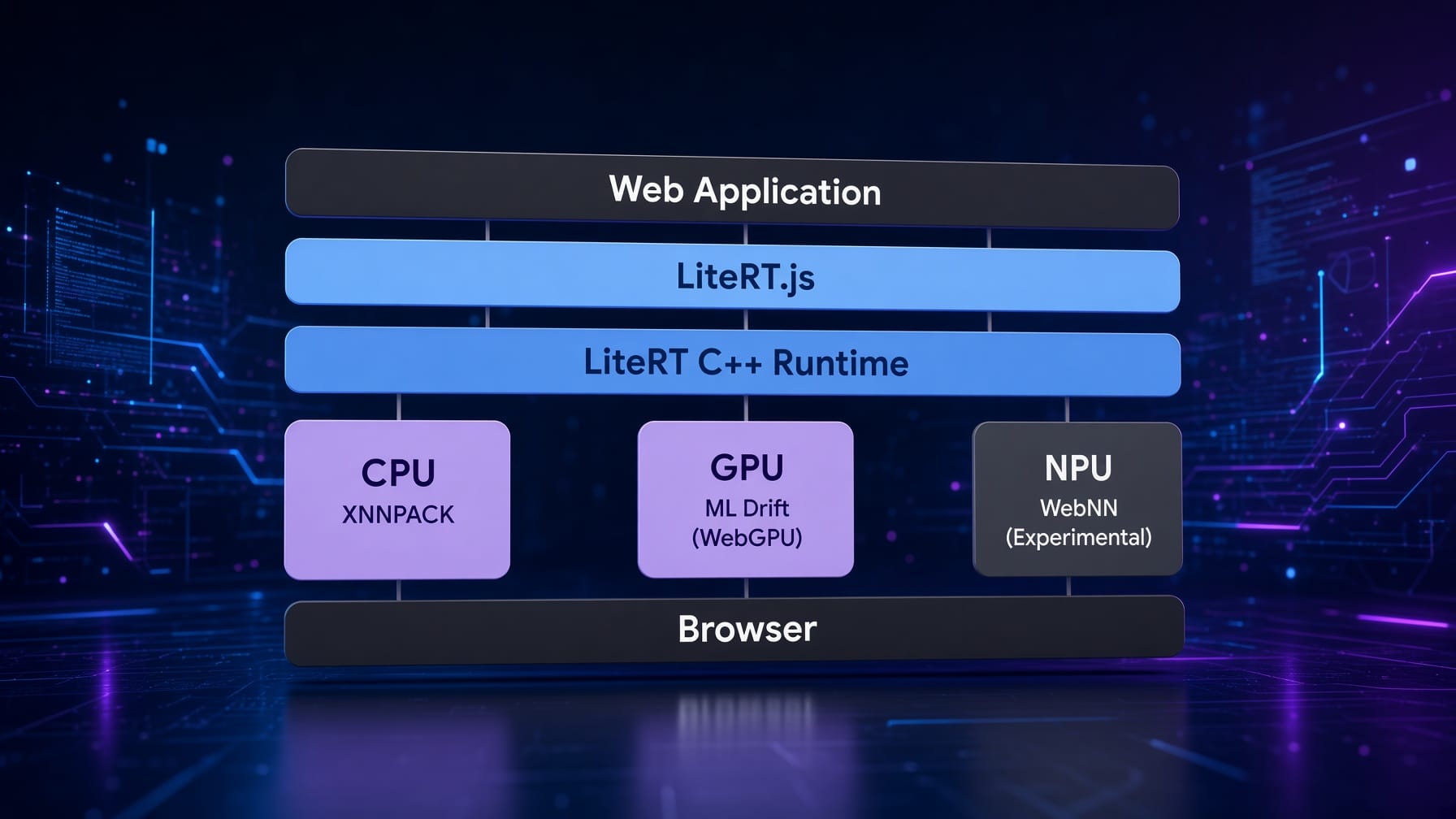
Google introduced LiteRT.js on July 9 as a JavaScript binding for running LiteRT models directly in the browser. The release matters because this is not a browser-only inference experiment. It brings Google's cross-platform on-device runtime to the web, with a JavaScript API sitting above the same C++ machinery used elsewhere in the LiteRT stack.
For teams already carrying .tflite models, that creates a fairly direct route into browser inference. Models can execute through XNNPACK in WebAssembly on the CPU, ML Drift over WebGPU on the GPU, or the emerging WebNN API for dedicated accelerators.
More than another TensorFlow.js backend
The interesting architectural choice is that LiteRT.js exposes Google's native runtime through WebAssembly instead of rebuilding every operator as a JavaScript kernel. WebGPU provides the accelerated GPU path, while tensors and graph execution stay inside the LiteRT model.
The surrounding toolchain is part of the story. LiteRT Torch converts compatible PyTorch models, the AI Edge Quantizer handles model-specific compression, and a model tester checks whether a graph can execute on WebGPU or WebNN before benchmarking it. The current @litertjs/core package is available on npm under Apache 2.0, and the launch includes browser demos for vector search, YOLO object detection, monocular depth estimation, and image upscaling.
Fast, inside a narrow benchmark
Google reports that LiteRT.js outperformed other web runtimes by up to 3x across the CPU and WebGPU comparisons it published. The chart covers EfficientNet, Inception V3, ResNet-50, Whisper Base, and YOLO26n. A second comparison reports 5x to 60x speedups when using WebGPU or WebNN instead of the runtime's CPU path for selected workloads.
The compatibility work does not disappear
WebGPU acceleration still depends on whether a particular model graph is supported. Google's getting-started guide also calls out static tensor dimensions and PyTorch export constraints, which means arbitrary models do not become browser-ready by changing one import. Production applications will need capability checks, tested model revisions, and a CPU fallback when adapter creation or graph compilation fails.
Even with those limits, LiteRT.js is a meaningful addition to the WebGPU compute ecosystem. It gives existing LiteRT users a browser target, connects browser inference to a mature cross-platform model pipeline, and makes WebGPU one backend in a larger deployment system rather than a hand-written collection of kernels.
Source: LiteRT.js, Google's high performance Web AI Inference by Ping Yu, Marko Ristić, Matthew Soulanille, and Chintan Parikh.