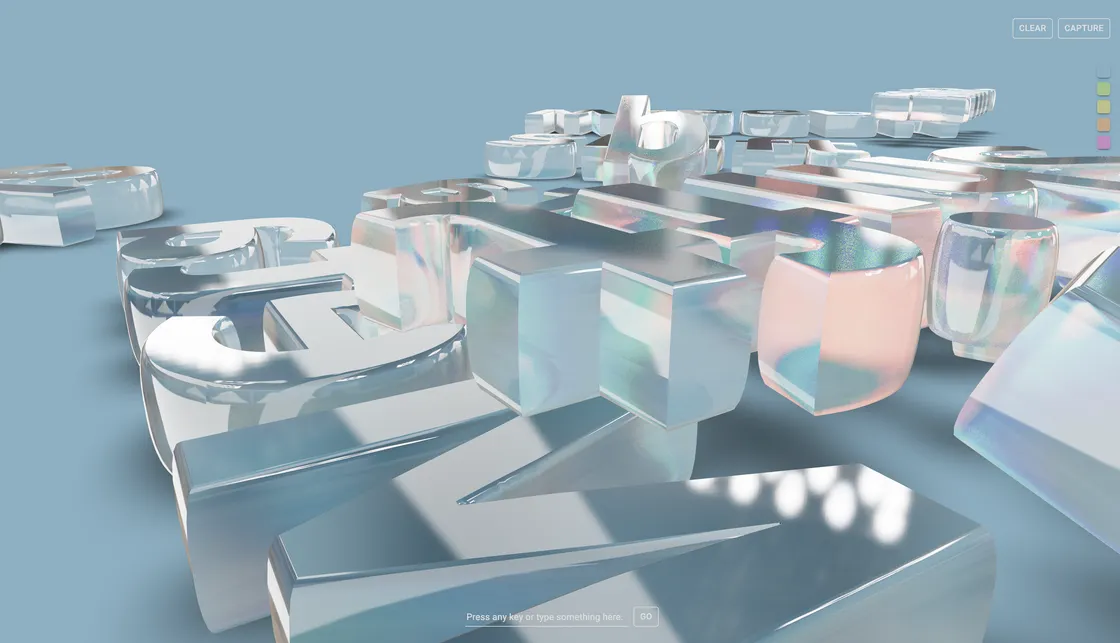

Igloo Inc: Crystal Growth Algorithms, Shader-Driven UI, and Volume Data Abeto built the Igloo Inc site entirely in WebGL, from procedurally grown ice crystals to shader-driven UI text. The particle footer alone, powered by custom VDB-to-browser volume data, is worth the scroll.
Galaxy Sim: Real-Time N-Body Galaxy Formation in WebGL Watch 20,000 particles collapse from random gas clouds into a spinning spiral galaxy, all running in your browser. The result is quietly mesmerizing.
gpu-curtains: A WebGPU 3D Engine That Syncs Shaders to Your DOM Martin Laxenaire rebuilt his DOM-to-shader library for WebGPU, and this time it's a full 3D engine. Lights, shadows, compute shaders, glTF support, and the same trick that made curtains.js useful: your HTML elements become shader geometry that scrolls and resizes like native DOM.
UNESCO's Virtual Museum of Stolen Artifacts, Rebuilt in 3D with NanoGL A WebGL museum you weren't expecting to need. makemepulse rebuilt 240+ looted artifacts in 3D using their in-house NanoGL framework and a generative AI pipeline that turns flat photos into textured models. Architect Francis Kéré designed the space. The subject matter does the rest.
MANA Yerba Mate: An Animated Shopify Store MANA Yerba Mate runs Three.js inside a Shopify storefront, rendering scroll-driven 3D worlds for each flavor alongside GSAP and Lottie animation layers. There's a playable game hidden in the footer.
Embedding Atlas: Apple's Open-Source Tool for Exploring Millions of Vectors in Your Browser Apple's Embedding Atlas renders millions of embedding points interactively using WebGPU (with WebGL 2 fallback), Wasm-compiled UMAP, and density-based clustering that runs in milliseconds. Open source, with React, Svelte, Jupyter, and CLI support.
SWOOOP: Low-Poly Biplane Flight in PlayCanvas A low-poly biplane circles a floating island, collecting gems while physics and ambient occlusion do the heavy lifting. Built in WebGL with PlayCanvas in just four weeks by a remote team across Athens and London.
In The Clouds: Tallest Buildings as 40-Meter Blocks The world's tallest buildings rendered as stacked 40-meter blocks in Three.js. One block equals four floors. Pure client-side WebGL with procedural geometry. No map tiles, just height data and math.
Škoda Vision Concept: Automotive-Grade 3D in the Browser Bao Nam Doan built a real-time 3D Škoda concept car viewer that looks like it belongs in a design studio, not a browser tab. React Three Fiber, WebGL, and the kind of lighting that makes you forget you're on the web.
curtains.js: DOM-Driven WebGL Textured Planes Martin Laxenaire's lightweight WebGL library that converts HTML elements into shader-driven textured planes positioned exactly where your CSS says they should be. Write normal markup, add shaders, skip the coordinate math.
Erfan Mirasadi's Three.js Portfolio with Theatre.js Choreography A 3D interactive portfolio built with Three.js, Theatre.js, and Next.js that actually runs smoothly on mobile. Draco compression keeps geometry lean, code-splitting prevents bundle bloat, and touch controls work like they should.
Morgan Motor's Car Configurator Apache's WebGL configurators for Morgan's Supersport and Plus Four run fast on mobile and look sharp on desktop. Wonderland Engine keeps it lightweight. The kind of product viz work worth studying.
WebHeat: GPU-Powered Thermal Simulation for Any STL File A high school senior learned Newton's law of cooling in class, then built a full thermal simulation in the browser. Drop in any STL, watch heat propagate through voxelized geometry on the GPU. WebGPU compute shaders, React frontend, and a useRef trick that keeps it all from falling apart.
PLAIN: Generate Low-Poly 3D Terrain Graphics in Your Browser PLAIN creates low-poly 3D plane graphics using vertex geometry and simplex noise. Displace a grid into terrain. Animate the surface. Control camera, color, shape. Export stills or loops. Built in p5.js.
The Bartlett Summer Show 2020: 32 Walkable Gallery Rooms Hello Monday built 700 architecture students a gallery that fits in a browser tab. Three.js renders 32 walkable rooms. The seamless jumps between 3D exploration and flat project pages proved something: the browser is a legitimate exhibition space now.
AI Grid: Run LLMs in Your Browser, Share GPU Compute with the World AI Grid connects browser tabs into a peer-to-peer compute mesh. Run LLMs locally with WebGPU, share spare GPU cycles, or borrow from others. No installs, no cloud. Just a URL and your graphics card.