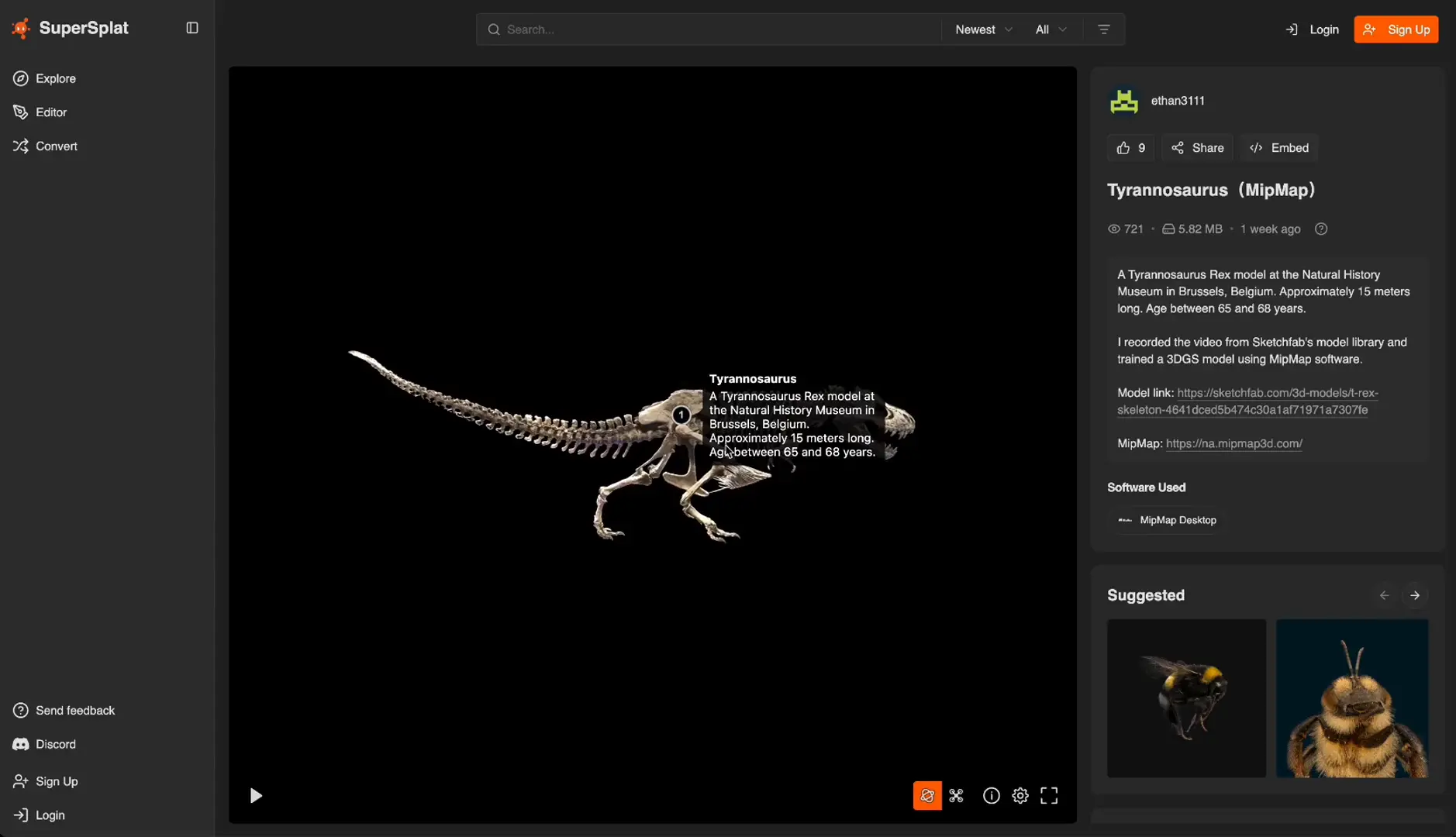
Gaussian splats are a strange kind of magic. Get close and the illusion falls apart into a swarm of soft, semi-transparent ellipsoids, a galaxy of colored lint that has no business resolving into anything. Pull back and there it is: a coffee shop, a carpenter ant at uncomfortable resolution, the actual Moon rebuilt from Artemis II data. SuperSplat is the workshop where people clean these things up. It runs entirely in the browser, nothing to install, and the Explore gallery alone earns the click.
What makes it interesting is that it treats a cloud of several million Gaussians like a document you can edit. Select with a brush, a lasso, a sphere, or an eyedropper that matches color within a threshold you set. Everything runs on the GPU, intersection testing included, so picking a subset of five million blobs stays real-time instead of turning your laptop into a space heater. Edits go through a proper history stack with unlimited undo, a streamed LOD format handles scenes past ten million Gaussians, and a companion CLI converts between PLY, SPLAT and friends. Built on the PlayCanvas WebGL/WebGPU engine, MIT-licensed top to bottom. Drag a PLY into the editor and break something. The whole thing is on GitHub if you want to see how the selection and serialization actually work.
%22%3E%3Cpath%20fill-rule%3D%22evenodd%22%20d%3D%22m906.78%20339.47l-81.33-141.47-81.09%20141.46-81.11-141.46h-648.79l324.4%20565.87%20162.2-282.94%20162.2%20282.94%20162.2-282.94v-0.01l81.32-141.45z%22%2F%3E%3Cpath%20d%3D%22m515.43%20828.51c-209.17%200-378.73-169.56-378.73-378.73%200-3.11%200.16-6.19%200.23-9.28l-97.64-170.32c-24.31%2054.93-37.93%20115.66-37.93%20179.6%200%20245.35%20198.9%20444.25%20444.26%20444.25%20195.77%200%20361.85-126.69%20421.02-302.52-56.12%20138.93-192.17%20237-351.21%20237z%22%2F%3E%3Cpath%20d%3D%22m239.33%20191.68c69.09-73.59%20167.19-119.63%20276.1-119.63%20114.63%200%20217.31%2050.96%20286.74%20131.45l1.93-3.37%203.66-6.39c-80.48-113.26-212.62-187.21-362.14-187.21-148.64%200-280.12%2073.06-360.77%20185.15z%22%2F%3E%3C%2Fg%3E%3C%2Fsvg%3E)